13.1. Justification of Part 1 Policy
13.1.1. Where relevant information is available, the development plan
should indicate areas where land instability should be taken into account to
ensure that new development would not be at risk from subsidence, mine and
landfill gas emissions, landslips and rock falls, that development does not
take place in unstable locations or where expensive public engineering
operations would be necessary to safeguard the development. Where there is
uncertainty about stability, the responsibility for determining the
implications of such constraints remains with the developer.

Part 2
13.2. Introduction
13.2.1. Unstable land can be caused by natural or man-made processes. The
most common form of naturally occurring unstable land is landslips. Coastal
erosion also accounts for some instability in certain areas of the UK but
fortunately there are no significant examples within the County Borough.
Other natural causes can be caused by an increase or decrease in
groundwater; ground compression caused by landfill operations; and extreme
climatic conditions.
13.3. Unstable Land in the County Borough
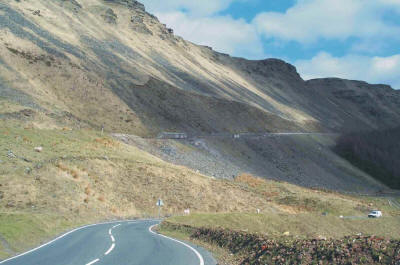
13.3.1. Within the County Borough, most known landslip areas are located
in an area north of a line drawn between Garth, Maesteg and Ogmore Vale. In
general, such landslips vary considerably in size and nature, and it is
fortunate that most are relatively isolated from settlement. Some landslips,
however, do abut some areas of housing and could cause physical damage to
property. It must be stressed, however, that the majority of landslip areas
will not be active in terms of movement on a regular basis.
13.3.2. In order to maximise the use of land for development, it is
essential that the physical constraints on the land are taken into account
at all stages of planning. Any scope for remedial, preventative, or
precautionary measures must also be fully explored so that land is not
sterilised unnecessarily.
13.3.3. It is important to acknowledge that the responsibility for
determining the extent and effects of instability or other risk remains that
of the developer. The Council’s role is therefore to highlight known or
potential risk in order that any development is carried out in a safe and
environmentally acceptable manner.
13.3.4. If instability cannot be overcome satisfactorily, the Council may
refuse planning permission. Alternatively, permission may be granted subject
to conditions which may require specialist investigation, assessment, and
mitigation by the developer.
13.3.5. Guidance on development affecting unstable land can be found in
the draft Technical Advice Note (TAN) - Wales, dated November 1996, and
parts of Planning Policy Guidance (PPG) Note No.14 (1990).
13.3.6. In view of the foregoing, the following policy is considered
appropriate for proposals which affect unstable land within the Borough.
13.3.7. DEVELOPMENT PROPOSALS ON UNSTABLE LAND
POLICY UNS1
WHERE PROPOSALS AFFECT LAND WHERE INSTABILITY IS SUSPECTED ANY PLANNING
APPLICATION MUST BE ACCOMPANIED BY A STABILITY REPORT WHICH:-
1. IDENTIFIES AND ASSESSES THE DEGREE OF INSTABILITY;
2. IDENTIFIES THE MEASURES REQUIRED TO MITIGATE AGAINST ANY RISK IDENTIFIED
IN 1 (ABOVE);
3. STIPULATES ROUTINE MONITORING WHERE APPROPRIATE; AND
4. ADDRESSES THE NEED FOR FORMAL ENVIRONMENTAL ASSESSMENT ARISING FROM ANY
STABILISATION WORKS.
<<
Previous Chapter |
Next Chapter
>> |