2.1. Sustainable Development
2.1.1. The concept of
"Sustainable Development" has been endorsed at the highest level by most of the
world's governments and this is now a major influence on the policies in this
Unitary Development Plan. Sustainable development is commonly defined as
"development that meets the needs of the present without compromising the
ability of future generations to meet their own needs". Put another way it is
about ensuring a better quality of life for everyone, now and for future
generations to come.
2.1.2. Sustainable development has wide ranging implications and is not
simply confined to environmental protection. To achieve it, four objectives must
be met simultaneously, namely:-
- The need for social progress which recognises the needs of everyone;
- The necessity for effective environmental protection;
- The requirement for a prudent use of natural resources;
- The importance of economic growth and employment.
Although the concept of 'sustainable development' and how it has developed as
over-riding principle, is dealt with in greater detail in the Environment
Chapter (section 3.3 refers), each topic chapter in turn addresses the general
aims of the concept.
2.1.3. Bridgend County Borough Council fully endorses the concept of
Sustainable Development and it is a primary concern of this Unitary Development
Plan to balance and integrate the above objectives when new development is
proposed. In this context the guiding principle of this Unitary Development Plan
is:-
TO IMPROVE THE QUALITY OF LIFE FOR THE RESIDENTS OF BRIDGEND COUNTY BOROUGH
IN WAYS WHICH ARE COMPATIBLE WITH THE PRINCIPLES OF SUSTAINABLE DEVELOPMENT.
2.1.4. This guiding principle was endorsed in the Land Use Strategy produced
as background to the UDP. It was translated into a number of more specific
objectives for each of the topic areas of the plan. These objectives are:-

2.2. Aims and Objectives
2.2.1. Environment
- To continue to protect the countryside for the sake of its landscape,
natural resources, and to conserve and enhance its agricultural, ecological,
geological, physiographic, historical, archaeological and recreational value;
- To promote and conserve the biodiversity of the County Borough and to
encourage the management of features of the landscape which are of major
importance for wild flora and fauna, in co-ordination with the Council's
approved Local Biodiversity Action Plan;
- To seek the enhancement of the rural economy taking into account the need to
maintain a viable agricultural sector;
- To define, and provide a co-ordinated policy framework for the ongoing
planning and management of the coastal zone of the County Borough in its
sub-regional context;
- To enhance the appearance of the built environment and to improve the quality
of new development;
- To define, protect, maintain and enhance the historic built environment, i.e.
the ancient monuments, archaeological sites, listed buildings, conservation
areas, and historic parks, gardens and landscapes of the County Borough.
2.2.2. Housing
- To make provision for the future housing needs of the County Borough by
identifying sufficient land to provide for 9,950 dwellings in the period
1996-2016 consistent with the principle of sustainable development;
- To cater for an adequate range of housing by co-ordination with the
findings of Housing Strategy and the 2002 Housing Needs Survey for the County
Borough which will identify specific local and social needs;
- To promote urban renewal by encouraging the use of brownfield sites and
existing buildings for new housing uses.
2.2.3. Employment
- To promote equality and opportunity by providing all residents with the
right of access to employment opportunities appropriate to their skills;
- To promote the use and conversion of existing appropriate brownfield sites and
redundant or under-utilised buildings for industrial and commercial development;
- To ensure that sufficient land is available to meet the job requirements of
the population and varying needs of industry, wherever possible close to
existing and proposed residential communities;
- To ensure that an adequate supply of readily developable land is available by
the maintenance of a land-bank;
- To enrich the economy by safeguarding existing employment in terms of sites
and opportunities, and securing new investment;
- To develop the locational advantages of the M4 corridor by reserving sites
near the strategic highway network for special employment purposes.
2.2.4 Transportation
- To adopt a corridor management approach in the development and improvement
of the total transport network;
- To protect and improve the environment by the introduction of various
transportation and traffic measures that reduce the use of cars, and encourage
cycling and walking;
- To restrict private non-residential parking in appropriate locations as part
of the strategy to reduce the use of cars;
- To encourage the use of public transport as a major mode of travel, especially
for the journey to work, by developing an inter-modal transport network;
- To encourage development to locate in areas where all sections of the
community have equitable access.
2.2.5. Retailing
- To reduce the high level of leakage of expenditure on comparison goods to
centres outside of the County Borough;
- To protect the existing retail hierarchy;
- To protect and enhance the viability, attractiveness and vitality of the town
and district centres in the County Borough;
- To promote alternative methods of travel for shopping trips;
- To promote the role of smaller shopping centres and free-standing local shops
in the County Borough;
- To promote and protect shopping opportunities which are in close proximity to
residential areas.
2.2.6. Tourism and Leisure
- To balance and integrate the needs of tourism, host communities and the
environment, including support for ecotourism, whilst protecting environmentally
sensitive areas;
- To encourage the development of good quality accommodation for tourists and
the business markets in suitable locations, including the upgrading and
improvement of existing facilities;
- To encourage environmentally sustainable tourist and leisure developments in
and around Bridgend and in the M4 corridor. This should be linked to
improvements in tourism, leisure and cultural facilities and activities in the
town centres of the County Borough. This can be realised through the
implementation of proposals contained in the various regeneration strategies,
particularly the strategies for Bridgend, Maesteg and Porthcawl town centres;
- To support the further enhancement and development of Porthcawl as a major
tourist resort, through the implementation of the Porthcawl Resort Regeneration
Strategy.
2.2.7. Sport and Recreation
- To remedy the existing deficiencies in the provision of recreation
facilities where these are compatible with the conservation of the urban and
rural environment;
- To protect existing recreation facilities against inappropriate development
and encourage their wider public use;
- To provide the required range of recreation facilities in accessible locations
throughout the County Borough, compatible with the conservation of the urban and
rural environment and in accord with the Council's Countryside Strategy.
2.2.8. Social and Community Facilities
- To provide the required range in type and location of social and community
facilities throughout the plan area, compatible with the conservation of the
urban and rural environment.
2.2.9. Minerals
- To make adequate provision for aggregate production to meet the County
Borough's current contribution to regional demand;
- To secure the efficient and appropriate use of aggregate minerals by
encouraging the use of secondary and recycled materials as an alternative to
primary aggregates;
- To provide adequate land to ensure the continued supply of high purity
limestone for the non-aggregate industrial market;
- To examine whether there are sites which are acceptable environmentally for
opencast coal extraction and which would bring about benefits to the local
community.
2.2.10. Waste Disposal
- To make provision for a range of waste management and disposal facilities
in line with the objectives set out in Wise about Waste the National Waste
Strategy for Wales published in June 2002.
2.2.11. Unstable Land
- To make the general public, including developers, aware of the extent and
nature of unstable land within the County Borough utilising the available data
base;
- To maximise the use of such land for development by satisfying the need to
ensure that all physical constraints have been identified, including the scope
for remedial, preventative, or precautionary measures where appropriate.
2.2.12. Energy and Utilities
- To increase energy efficiency through appropriate development design,
having regard for features such as the layout, orientation, mix of uses, density
of development, use of materials and landscaping.
- To ensure that the County Borough's reasonable needs for energy and utilities
are satisfied, and the area's energy potential from local renewable sources and
water usage is optimised, consistent with the need to conserve the environment.
2.2.13. Regeneration
- To safeguard past investment particularly in urban areas, provide greater
certainty for future investment and support the regeneration sector of the
economy;
- To improve the quality of the County Borough's infrastructure, including its
buildings and public realm;
- To identify and provide land use framework for addressing and prioritising
social needs;
- To support community development, remove social exclusion and reduce crime;
- To make better use of existing resources such as land and buildings, reduce
the need to travel, assist in removing urban decay, facilitate energy
efficiency, enhance biodiversity and reduce pressure on the countryside;
- To stimulate greater participation in, and public ownership of planning
decisions and provide a focus for community activity;
- To assist in the improvement of educational and employment skills.
2.2.14. Implementation, Resources & Monitoring
- To maximise the use of available resources for plan implementation;
- To monitor and evaluate the UDP so as to inform the community, plan users and
the planning authority about the effectiveness of the policies and proposals,
and to provide an input to review and subsequent alteration.
2.3. Land Use Strategy
2.3.1. A central part of the Land Use Strategy which was produced as a
background to this UDP involved estimating the future dwelling requirement and
consequently household change for the County Borough, which translates into a
population forecast. Housing development is, and will continue to be a principal
consumer of land. It is therefore appropriate that detailed consideration be
given to this matter.
2.3.2. The population of the area now covered by Bridgend County Borough has,
in general, grown continuously over the past thirty years. Population growth in
the area has not been uniform as the levels of growth recorded in the 1960s
exceeded any subsequent growth rates. Since the 1960s when the population of the
area increased by over 11% the rate of growth has been more modest.
Nevertheless, the area's population has continued to grow and overall the
population grew approximately 19% between 1961 and 2001.
2.3.3. At the heart of the land use strategy is an assumption that most of
the housing sites allocated in the previous development plan will be developed
over its lifespan i.e. up until 2006. However it is recognised that some of the
sites have infrastructural, topographical or even contamination problems which
may inhibit their development. As a consequence, the County Borough Council has
re-assessed the residential land bank and has excluded certain sites which are
considered unlikely to be developed in the period up until 2016. At the same
time, in order to compensate for the loss of these sites, new allocations have
been included which are considered to have more development potential. A fuller
explanation of this process together with a detailed list of these new sites is
contained in the Housing chapter in Part 2 of this plan.
2.3.4. The population forecast for the plan was produced using the Chelmer
Population and Household Model. The core data is 1991 census based, although the
model has been refined to include 1998 local correction factors for births,
deaths and net migration. In addition, 1998 based fertility and mortality rates
have been incorporated. The population forecast was produced by inputting the
known and anticipated building programme from 1996 to 2016. The anticipated
building programme is based on an average completion rate of 490 dwellings per
annum. This average build rate reflects that of the 19 year period from 1981 to
2000, and is therefore considered to represent the most robust basis for
predicting future building activity during the plan period.
2.3.5. By adopting these assumptions, the population of the County Borough is
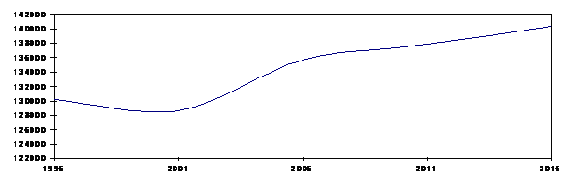
forecast to increase by 10,143 persons to a total of 140,375 by 2016. The main
components of this projection are shown in
Table INT1, and the level of
population change is shown in Figure INT1.
Table INT 1 Population Forecast
|
|
1996 |
2001 |
2006 |
2011 |
2016 |
|
Building Programme1 |
|
2600 |
2450 |
2450 |
2450 |
|
Total Dwellings |
53,460 |
55,158 |
58,160 |
60,502 |
62844 |
|
Vacancy Rate |
5.00% |
5.00% |
5.00% |
5.00% |
5.00% |
|
Total Households |
50,973 |
53,342 |
55,455 |
57,689 |
59,919 |
|
Average Household Size |
2.58 |
2.38 |
2.41 |
2.35 |
2.30 |
|
Total Population |
130,232 |
128,650 |
135,631 |
137,877 |
140,375 |
Source Bridgend County Borough Council's Anticipated Housing Completions
Figure INT 1 Projected Population Change
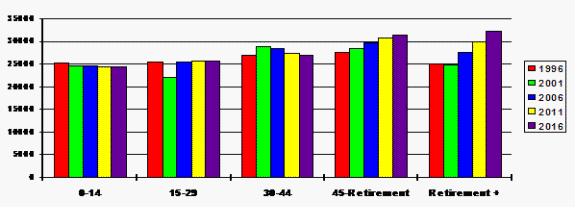
2.3.6. The age profile of the County Borough is expected to change quite
dramatically over the plan period, and is illustrated in
Figure INT2. The
proportion of the population over the age of retirement is expected to rise from
19.2% in 1996 to 22.9% in 2016, representing a net increase of 7,120 persons.
The progressive ageing of the population is compounded by anticipated losses of
population in the younger age groups. The population in the age group 0-14 is
expected to fall by 4.0% over the plan period. The persons in the 30-44
economically active age band will remain almost static, however the older
economically active population over the age of 45, is forecast to increase by a
net figure of 3702 persons.
Figure INT 2 Population Change by Age Band
2.3.7. As the total population is forecast to increase over the plan period,
so the average household size is predicted to decrease. The reduction in the
average household size is a national trend and factors such as an increasing
divorce rate, higher life expectancy and a propensity for young single people to
set up home for themselves are major factors which explain this trend. The
number of households in Bridgend County Borough is projected to increase by
8,946 to 59,919 in 2016. This forecast is higher than the Welsh Office's 1994
Household Projection for Wales; however this set of projections adopts a
different set of assumptions, and starts from a different base date, which
mitigates against direct comparisons. The Welsh Office forecast the number of
households in Bridgend County Borough to increase by 7,000 between 1996 and
2016.
2.3.8. Having arrived at an appropriate level of anticipated population and
household growth, it is necessary to consider the mechanisms by which this
growth may be accommodated. As already stated, to a large extent the ability to
radically alter land use patterns in the context of the UDP is limited. Major
areas of land have already been identified in the existing development plan,
many of which have the benefit of extant planning consents, and it would not be
feasible to revoke these consents given the resources available to the Local
Planning Authority. It is to be expected therefore, that most of the new
development will take place on sites which were allocated in the previous
development plan. The major issue is how the additional housing requirements
will be accommodated beyond 2006 which is the end date of the Ogwr Borough Local
Plan. This issue was considered at some length in the Land Use Strategy produced
as background to this Unitary Development Plan and it is felt that the most
sustainable option is that of limited dispersal of growth.
2.3.9. In essence, this approach attempts to accommodate the requirement for
additional dwellings on a number of sites distributed primarily within the main
settlements of the County Borough. This approach of developing on a greater
number of relatively small housing sites will not be able to generate economies
of scale to the same degree as developing on a few large sites. The provision of
new facilities and improvements to the highway network could also be more
limited and indeed it could be argued that additional pressures will be put onto
the existing facilities. However, nearly all the new sites additional to those
identified in the previous development plan are either brownfield, substantially
brownfield or under-used urban sites within the main settlements, in accordance
with the principles of sustainability.
2.3.10. It is accepted that this approach could put additional pressure on
the existing infrastructure. However, much would depend on the location and
characteristics of the actual sites identified. By concentrating growth on the
main urban areas the relatively small number of additional dwellings if
dispersed carefully could be absorbed on brownfield sites without radically
changing the character of the environment. If such sites were further
strategically located in close proximity to the existing facilities and the
major road network then their impact on the wider environment could be limited.
2.3.11. This would therefore point the way to the preferred Land Use Strategy
being that of :-
LIMITED DISPERSAL OF NEW DEVELOPMENT IN THE MAIN URBAN AREAS, WHEREVER
POSSIBLE ON REDUNDANT OR UNDER-UTILISED URBAN LAND AND OPTIMISING THE USE OF
COMMITTED DEVELOPMENT SITES.
2.3.12. The Council has also taken into account the advice contained in
Planning Policy Wales (2002) (para. 2.10) and PG(W)TAN20 - 'The Welsh Language -
Unitary Development Plans and Planning Control'. It does not consider that there
are communities within the County Borough where the use of the Welsh Language is
currently part of their social fabric for the purpose of either strategic or
detailed planning policy generation.
2.4. Sustainability Appraisal
2.4.1. In order to help ensure that the over-riding principles of Sustainable
Development are given due consideration, and are accorded their necessary
priority, government advice recommends that local planning authorities assess
the environmental impact of their policies. This is most effectively achieved by
a systematic sustainability appraisal of the plan. Such an exercise would also
help to ensure that the objectives of a policy are clearly laid out and that
trade-offs between options have been identified and assessed.
2.4.2. To be effective, the sustainability appraisal should be integrated
into each stage of the plan making process. The sustainability appraisal of this
plan reflects this, as all of the stages of plan production to date, which have
been previously outlined, have been subjected to a sustainability appraisal.
2.5. Related Strategies
2.5.1. Government legislation places a duty on all unitary authorities in
Wales to prepare Community Strategies for promoting or improving the economic,
social and environmental wellbeing of their areas, and for contributing to the
achievement of sustainable development in the UK.
2.5.2. Guidance received from the National Assembly for Wales clarifies how
the Council should build on the work it has already undertaken on initiatives
such as corporate and community planning, regeneration, social inclusion and
sustainable development in order to develop its Community Strategy. The latter
should be viewed as providing the overarching strategic framework for all other
plans and strategies for the County Borough, so that people can see the
relevance of those plans and the contribution that they will make to its
Community Strategy. The policies and spatial proposals of the UDP therefore
constitute a crucial input to the Community Strategy which the Council is
currently preparing. Similarly, as the latter takes shape, relevant proposals
and targets which would have direct implications for future land use will inform
the future review of the UDP.
2.5.3. In pursuing its own commitment to sustainable development, Bridgend
County Borough Council like all Local Authorities in the United Kingdom has
produced a Local Agenda 21 Strategy which encompasses the principles of
Sustainable Development. The Local Agenda 21 Strategy is a broad non-land use
based document which is complementary to the land use policies in the UDP.
2.5.4. In addition, a number of other strategies have been produced by the
County Borough Council which have some direct bearing on the UDP. These are the
Authority's:-
- A Sustainable Economic Regeneration Strategy for Bridgend County Borough;
- Transportation Strategy;
- Countryside Strategy and Integrated Action Programme;
- Built Heritage Strategy;
- Coastal Zone Management Plan;
- Local Biodiversity Action Plan;
- Local Air Quality Reviews;
- Crime Reduction Strategy;
- Bridgend County Tourism Strategy; and
- Housing Strategy;
as well as specific regeneration strategies relating to:-
- Porthcawl;
- Garw Valley;
- Bridgend Town Centre;
- M4 Corridor;
- Llynfi Valley;
- Ogmore Valley; and
- Cynffig Community.
2.5.5. Also, the government's White Paper on 'The Future of Transport', and
former Welsh Office publication 'Transporting Wales into the Future', identify
the formulation of local transport plans which will embody, among others, Green
Commuter Plans and Safe Routes to Schools.
<< Previous Chapter |
Next Chapter
>> |