|
1.1 What is a Unitary Development Plan?
1.1.1 This is the first Unitary Development Plan to be prepared by Bridgend
County Borough Council and is referred to throughout this document as the UDP.
1.1.2 Government legislation requires that each Unitary Authority in Wales
should prepare a UDP which will replace any existing development plans covering
their area, and furthermore that the UDP should be prepared as soon as possible.
1.1.3 The plan is called a Unitary Development Plan because it consists of
both strategic and local planning policies for the area. Previously these were
covered separately in different plans, and prior to local government
re-organisation in 1996, these were generally prepared by different authorities.
1.1.4 The Government has produced guidance for Unitary Authorities to assist
with the production of their UDPs in the form of Planning Policy Wales (March
2002) and Planning Guidance (Wales) Unitary Development Plans. This guidance is
supplemented by a series of Technical Advice Notes which provide detailed advice
on specific topics to be addressed, and this UDP reflects this guidance.
1.1.5 The UDP must contain policies and proposals for the development and use
of land in the County Borough, and in particular, should include land use
policies and proposals for:-
- Housing;
- Conservation and improvement of the natural and built environment,
including through better design and use of Green Belts if appropriate;
- Economy, including agriculture, forestry, industry, business, retail and
other employment-generating and wealth-creating development;
- Land use/transportation strategy addressing accessibility and the
provision of strategic and integrated transport facilities including
highways, railways and other infrastructure;
- Mineral working (including disposal of mineral waste) and the protection
of mineral resources;
- Safeguarding of natural resources;
- Waste management and disposal, land reclamation, re-use and hazards;
- Tourism, leisure, sport and recreation;
- Energy conservation and generation, including renewable energy.

This Plan covers the period up to 2016.
1.1.6 When adopted, the UDP will replace the current development plan for the
area which comprises the Mid Glamorgan Replacement Structure Plan, the Mid
Glamorgan Mineral Local Plan for Limestone Quarrying and the Ogwr Borough Local
Plan. Taken together, these plans have an end date of 2006. The current
development plan contains land allocations which are under construction or have
the benefit of planning consent and the UDP will have to acknowledge many of
these commitments.
1.1.7. Section 70(2) of the Town & Country Planning Act 1990 requires that
any decision with respect to a proposed development shall have regard to the
development plan, so far as it is material to the application, and to any other
material considerations. Where the development plan is material to the
development proposal, and must therefore be taken into account, section 54A of
the Act (inserted by section 26 of the Planning and Compensation Act 1991)
requires the application to be determined in accordance with the plan, unless
material considerations indicate otherwise.
1.1.8. In taking development control decisions, the Local Planning Authority
will ensure that any proposal is assessed against all the policies that are
relevant to it.
1.2 Format of the UDP
1.2.1 The UDP is comprised of a Written Statement and a Proposals Map.
The Written Statement comprises two elements:-
Part 1
Consists of a very brief statement of the strategic policies for the area.
These policies provide a context and framework for the more detailed policies
and proposals contained in Part 2.
Part 2
Consists of more detailed polices and proposals. Part 2 is divided into
fifteen chapters and related appendices. These cover the main topic areas of
Environment, Housing, Employment, Transportation, Retailing, Tourism and
Leisure, Sport and Recreation, Social and Community Facilities, Minerals, Waste,
Unstable Land, Energy and Utilities, Regeneration and Implementation and
Resources; and
The Proposals Map which includes:-
Inset Maps that show, on an Ordnance Survey base of the County Borough, the
physical expression of the policies and proposals in the Written Statement.
1.2.2. In writing its policies, the LPA has used will or will not be
permitted wherever appropriate, sometimes subject to a proposal satisfying
certain criteria. There are other instances where the full acceptability or
otherwise of a development proposal is not clear-cut by reference to one policy
alone. In such cases, which require further assessment in respect of other
policies of the Plan or material considerations, the LPA has used the words will
be favoured or will not be favoured.
1.3 The Area Covered by the UDP and Regional Planning
Context
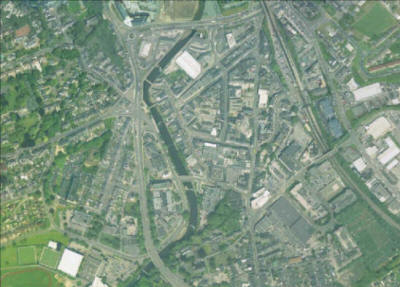
1.3.1 The UDP covers the whole of the County Borough of Bridgend. The County
Borough is at the geographical heart of South Wales. It covers an area of
approximately 25,500 hectares, and in 2001 had a population of 128,650.
1.3.2 The County Borough extends approximately 20km from east to west,
encompassing the Ogmore, Garw and Llynfi valleys to the north, and bordering the
Bristol Channel to the south. The largest settlements are the towns of Bridgend
and Maesteg and the seaside resort of Porthcawl. Bridgend is the largest of
these settlements and is the administrative centre for the area.
1.3.3 The County Borough has an excellent transportation infrastructure with
the M4 motorway traversing the southern part of the County Borough in an
east-west alignment, providing fast road access to Cardiff, Swansea, the rest of
South Wales and beyond. Additionally, an inter-city high speed rail service
linking the area with the whole of the national rail network, provides fast and
efficient rail transport, whilst Cardiff-Wales Airport is only 19 kilometres
away.
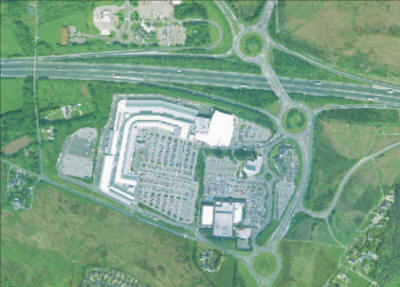
1.3.4 Access to the motorway system is facilitated by 3 motorway junctions at
Pencoed, Sarn and Pyle. The locational advantages largely attributed to the
motorway has seen the 'M4 Corridor' attracting considerable inward investment,
as well as being a focus for out-of-town retail developments. The area has also
been the preferred location for most of the major volume house builders. Indeed,
the M4 Corridor has seen rapid expansion and major releases of land for
development over the past 15 years, with the focus being on Bridgend and its
environs.
1.3.5 Meanwhile, in contrast to the M4 Corridor, many of the valley
communities in the north of the County Borough are experiencing problems of
deprivation. These areas previously dependent upon the coal and iron industries
have suffered the most in terms of the dramatic shift in the structure of the
local economy over the past 30 years or so, and have been starved of new job
opportunities and of investment in general. Increasingly, what were once
cohesive and viable valley communities are becoming fragmented and excluded from
the benefits of economic growth. The falling population and changes in retail
patterns, particularly in the Ogmore and Garw valleys means that communities are
unable to sustain commercial ventures including essential shops, and
increasingly community facilities need to be heavily subsidised.
1.3.6 The changing fortunes of the communities of the County Borough are
closely tied in with the changes which have taken place in the economy. Many of
the communities in the County Borough owe their origins to the iron and coal
industries which formed the lifeblood of the area for much of the past 100
years. However, since the 1940s these traditional heavy industries have
gradually disappeared. New employment opportunities were created as modern
manufacturing enterprises established primarily in the southern part of the
County Borough, along the major road network. This area is now home to many
important international manufacturing establishments. Manufacturing is an
important source of jobs in the local economy, however, most of the workforce in
the County Borough are employed in the service sector.
1.3.7 Services, particularly Public Services such as the health service and
public administration are now the principal source of jobs in the area. Many of
the jobs that have been created in this sector have been taken by female workers
and women currently account for 59% of the workforce in the County Borough, a
significantly higher proportion than in the rest of Wales.
1.3.8. Planning Policy Wales (March 2002) encourages ongoing consultation and
collaboration between local planning authorities on issues of common concern and
those which cross boundaries. Bridgend CBC is a member of the South East Wales
Strategic Planning Group (SEWSPG) which comprises 10 unitary authorities and one
National Park Authority. The South East regional planning group coincides with
the National Assembly's Regional Committee area.
1.3.9. SEWSPG has produced two volumes of Regional Planning Guidance for
South East Wales. It is intended that these will promote a consistent policy
approach across the region, including a common set of strategic planning
objectives to provide an agreed context for the preparation of UDPs. Although as
it has been formulated in parallel with the first round of UDPs, the Council
takes the view that the regional guidance is not prescriptive. Rather, it will
help shape the policies of the UDP after due public consultation and the process
of public inquiry.
1.3.10. The Council awaits further clarification from the Assembly in respect
of the final status of the Regional Guidance.
1.3.11. In addition, as the County Borough is the westernmost unitary
authority within the South East Wales Group, it has regular independent liaison
meetings with Neath Port Talbot County Borough which forms part of the South
West Wales Strategic Planning Group. These meetings address issues of mutual
concern and further promote cross-border co-ordination of planning policies.
PART 1 POLICIES
ENVIRONMENT
POLICY 1
THE ENVIRONMENT OF BRIDGEND COUNTY BOROUGH IS A VARIED AND FINITE RESOURCE.
DEVELOPMENT WHICH ENHANCES, PROTECTS OR CONSERVES IT, WILL BE ENCOURAGED;
WHEREAS DEVELOPMENT WHICH DIMINISHES, ENDANGERS OR NEGLECTS IT, WILL NOT BE
PERMITTED.
ENVIRONMENT
POLICY 2
DEVELOPMENT IN THE COUNTY BOROUGH SHOULD SAFEGUARD THE INTEGRITY OF THE
COUNTRYSIDE AND THE BUILT ENVIRONMENT. THROUGH CAREFUL SITING, PLANNING AND
DESIGN, IT SHOULD PROTECT, CONSERVE AND ENHANCE:
1. INTERNATIONAL, NATIONAL, REGIONAL AND LOCAL BIODIVERSITY;
2. SPECIAL LANDSCAPE AREAS;
3. THE HISTORIC BUILT ENVIRONMENT; AND
4. THE COASTAL ZONE.
ENVIRONMENT
POLICY 3
DEVELOPMENT PROPOSALS WILL BE FAVOURED WHERE THEY EMBRACE OR ENCOURAGE:-
1. CONSERVATION, REDUCTION, RE-USE AND RECYCLING OF WASTE, POLLUTION CONTROL,
AND THE CONSERVATION OF NATURAL RESOURCES;
2. REDUCTION OF TRAVEL BY PRIVATE CAR AND VEHICLE MOVEMENTS, AND THE PROMOTION
OF CYCLING, WALKING AND THE USE OF PUBLIC TRANSPORT;
3. RECLAMATION OF DERELICT, DEGRADED OR CONTAMINATED LAND, AND ITS REMEDIATION
TO BENEFICIAL USES; AND
4. REGENERATION OF THE URBAN ENVIRONMENT.
HOUSING
POLICY 4
LAND WILL BE MADE AVAILABLE TO PROVIDE FOR A NET ADDITION OF 9,950 DWELLINGS
TO THE TOTAL HOUSING STOCK OF BRIDGEND COUNTY BOROUGH IN THE PERIOD 1996-2016.
EMPLOYMENT
POLICY 5
252 HECTARES OF EMPLOYMENT LAND WILL BE ALLOCATED TO SATISFY THE VARYING
NEEDS OF EXISTING INDUSTRY, INWARD INVESTMENT PROJECTS AND SMALL BUSINESSES.
TRANSPORTATION
POLICY 6
IMPROVEMENTS TO THE TRANSPORTATION NETWORK WILL BE CARRIED OUT TO:-
1. ENHANCE ROAD SAFETY;
2. DISCOURAGE INAPPROPRIATE CAR USE;
3. ENCOURAGE THE USE OF PUBLIC TRANSPORT AND OTHER ALTERNATIVE MODES;
4. PROMOTE ECONOMIC DEVELOPMENT;
5. PROVIDE ACCESS FOR ALL; AND
6. BENEFIT THE ENVIRONMENT.
TRANSPORTATION
POLICY 7
DEVELOPMENT WHICH CAN BE DEMONSTRATED TO PROMOTE AND ENCOURAGE THE FOLLOWING
WILL BE FAVOURED:-
1. EFFICIENT USE OF THE EXISTING HIGHWAY NETWORK;
2. INCREASE IN PUBLIC TRANSPORT USAGE;
3. REDUCTION IN THE NUMBER AND LENGTH OF CAR-BORNE JOURNEYS;
4. WALKING AND CYCLING; AND
5. PROVISION OF RAIL FREIGHT FACILITIES.
RETAILING
POLICY 8
THE EXISTING RETAIL HIERARCHY WILL BE PROTECTED AND MAINTAINED AND PARTICULAR
ENCOURAGEMENT WILL BE GIVEN TO PROTECTING AND ENHANCING THE VITALITY, VIABILITY
AND ATTRACTIVENESS OF EXISTING TOWN AND DISTRICT CENTRES.
RETAILING
POLICY 9
OUT OF CENTRE RETAILING WILL ONLY BE PERMITTED WHERE IT IS LOCATED ON AN
EXISTING OR ALLOCATED RETAIL SITE, AND/OR WHERE ALL THE FOLLOWING CRITERIA
APPLY:
1. A NEED FOR THE DEVELOPMENT HAS BEEN SATISFACTORILY
DEMONSTRATED;
2. IN SEQUENTIAL ORDER OF PREFERENCE, ALL TOWN CENTRE, EDGE OF CENTRE AND
DISTRICT CENTRE SITES, HAVE BEEN THOROUGHLY ASSESSED, AND NONE HAVE BEEN FOUND
TO BE SUITABLE AND AVAILABLE;
3. INDIVIDUALLY AND CUMULATIVELY, WITH OTHER EXISTING OR COMMITTED
RETAIL DEVELOPMENTS, THE POTENTIAL THREAT TO VITALITY, VIABILITY
AND ATTRACTIVENESS OF EXISTING CENTRES HAS BEEN ASSESSED AND
WOULD BE ACCEPTABLE;
4. THE ACCESSIBILITY TO THE PRIMARY ROAD NETWORK AND THE EFFECT ON TRAFFIC FLOWS
HAS BEEN ASSESSED AND WOULD BE ACCEPTABLE;
5. THE PROPOSAL WOULD BE WELL SERVED IN TERMS OF PUBLIC TRANSPORT.
TOURISM
POLICY 10
PROPOSALS FOR TOURISM DEVELOPMENT WILL BE FAVOURED WHERE:-
1. THEY CONTRIBUTE TO THE GROWTH OF THE LOCAL ECONOMY IN TERMS OF NEW
EMPLOYMENT OPPORTUNITIES AND BUSINESS CREATION; AND
2. THEY PROTECT AND CONSERVE AREAS OF THE LANDSCAPE, BIODIVERSITY, THE COAST AND
HISTORIC ENVIRONMENT WHICH ARE OF SPECIAL INTEREST, AND ARE SO LOCATED AND
DESIGNED THAT THEY CONSERVE OR ENHANCE THE QUALITY OF THE LOCAL ENVIRONMENT; AND
3. THEY RESPECT THE NEEDS AND AMENITIES OF LOCAL COMMUNITIES.
LEISURE
POLICY 11
PROPOSALS FOR LEISURE DEVELOPMENT, INCLUDING FOOD AND DRINK USES OUTSIDE THE
EXISTING COMMERCIAL CENTRES, WILL BE PERMITTED WHERE:-
1. A NEED FOR THE DEVELOPMENT HAS BEEN SATISFACTORILY DEMONSTRATED;
2.THE PROPOSED DEVELOPMENT DOES NOT THREATEN THE VITALITY, VIABILITY AND
ATTRACTIVENESS OF EXISTING TOWN AND DISTRICT CENTRES;
3. IN SEQUENTIAL ORDER OF PREFERENCE, ALL TOWN CENTRE, EDGE OF
CENTRE, DISTRICT CENTRE, EXISTING OUT OF CENTRE SITES, HAVE BEEN ASSESSED, AND
NONE HAVE BEEN FOUND TO BE SUITABLE AND AVAILABLE.
4. THE PROPOSED DEVELOPMENT WOULD BE WELL SERVED BY A CHOICE OF TRANSPORT, AND
CONTRIBUTE TO REDUCED RELIANCE ON TRAVEL BY PRIVATE CAR.
5. THE AMENITIES OF NEARBY RESIDENTS WILL NOT BE HARMED BY NOISE, SMELL, LITTER
OR OTHER ENVIRONMENTAL CONCERNS.
SPORT AND RECREATION
POLICY 12
DEVELOPMENT PROPOSALS WHICH CONTRIBUTE TO, AND / OR PROTECT SPORT AND
RECREATIONAL FACILITIES AND SERVICES WILL BE ENCOURAGED.
SOCIAL AND COMMUNITY SERVICES
POLICY 13
DEVELOPMENT PROPOSALS WHICH CONTRIBUTE TO, AND/OR PROTECT, SOCIAL AND
COMMUNITY FACILITIES AND SERVICES WILL BE ENCOURAGED.
MINERALS
POLICY 14
DEVELOPMENT PROPOSALS FOR MINERAL DEVELOPMENT WILL BE FAVOURED WHERE THEY
PROVIDE FOR THE CONTINUATION OF THE COUNTY BOROUGH'S SHARE OF REGIONAL
PRODUCTION SUBJECT TO:-
1. ENSURING THAT THE ENVIRONMENTAL IMPACTS OF EXTRACTION ARE ACCEPTABLE; AND
2. SECURING APPROPRIATE, HIGH QUALITY AND PROMPT RESTORATION AND AFTERCARE TO
PROVIDE FOR A BENEFICIAL AFTER-USE.
MINERALS
POLICY 15
MINERAL RESOURCES SHALL BE CONSERVED WHILE SECURING NECESSARY SUPPLIES BY
PROMOTING THE EFFICIENT USE OF PRIMARY AGGREGATES AND ENCOURAGING THE USE OF
ALTERNATIVE MATERIALS SUCH AS INDUSTRIAL BI-PRODUCTS AND RECYCLED MATERIALS.
MINERALS
POLICY 16
MINERAL RESOURCES LIKELY TO BE REQUIRED FOR EXTRACTION WILL BE SAFEGUARDED
FROM STERILISATION BY PERMANENT DEVELOPMENT.
WASTE
POLICY 17
DEVELOPMENT PROPOSALS SHOULD CONTRIBUTE TOWARDS THE PROVISION OF A RANGE OF
WASTE MANAGEMENT AND DISPOSAL FACILITIES WHICH:
1 MEET THE OBJECTIVES OF NATIONAL POLICY IN RESPECT OF THE PROXIMITY
PRINCIPLE AND THE WASTE HIERARCHY;
2 MEET TARGETS TO REDUCE THE AMOUNT OF WASTE DISPOSED OF BY LANDFILL, AND
INCREASE THE AMOUNT OF WASTE RECOVERED, COMPOSTED OR RECYCLED.
UNSTABLE LAND
POLICY 18
THE DEVELOPMENT OF UNSTABLE LAND OR POTENTIALLY UNSTABLE LAND, WHICH INVOLVES
THE ERECTION OF BUILDINGS OR STRUCTURES, WILL NOT BE PERMITTED UNLESS ADEQUATE
MITIGATION MEASURES ARE FIRST AGREED IN WRITING WITH THE LOCAL PLANNING
AUTHORITY AND SUBSEQUENTLY CARRIED OUT.
ENERGY AND UTILITIES
POLICY 19
DEVELOPMENT FOR TELECOMMUNICATIONS, UTILITY SERVICES OR THE EXPLOITATION OF
RENEWABLE ENERGY SOURCES WILL BE FAVOURED WHERE IT CAN BE DEMONSTRATED THAT ANY
ADVERSE EFFECT ON THE BEST AND MOST SENSITIVE ENVIRONMENTS (IN TERMS OF
LANDSCAPE AND SCENIC, ARCHITECTURAL AND HISTORIC, AND NATURE CONSERVATION VALUE)
WOULD BE MINIMAL.
ENERGY AND UTILITIES
POLICY 20
ALL DEVELOPMENT PROPOSALS SHOULD SEEK TO MAXIMISE ENERGY EFFICIENCY AND WATER
CONSERVATION IN THEIR LAYOUT, DESIGN, MATERIALS AND CONSTRUCTION.
REGENERATION
POLICY 21
ANY DEVELOPMENT WHICH IS LIKELY TO PUT A REGENERATION STRATEGY AT RISK WILL
NOT BE PERMITTED.
IMPLEMENTATION AND RESOURCES
POLICY 22
APPLICATIONS FOR BUILT DEVELOPMENT SHOULD INCLUDE MATERIAL PROPOSALS WHICH
DEAL WITH THE FAIR AND REASONABLE DIRECT AND INDIRECT INFRASTRUCTURAL
REQUIREMENTS OF THE DEVELOPMENT, AND WHICH ALSO ENSURE THAT THERE IS NOT A
CONSEQUENTIAL AND SIGNIFICANT PLANNING LOSS TO THE EXISTING COMMUNITY. WHERE
APPROPRIATE, SUCH PROPOSALS WILL BE SECURED BY MEANS OF PLANNING AGREEMENTS/
OBLIGATIONS.
<< Previous Chapter |
Next Chapter
>> |