12.1. Justification of Part 1 Policy
12.1.1. Government advice requires that development plans should make
provision for an adequate network of waste management facilities while
taking into account environmental considerations and having due regard for
the waste disposal plan for the area. In view of the difficulty in finding
land suitable for a landfill site, it is likely that the majority of the
County Borough’s waste arisings will continue to be exported to sites
outside the County Borough boundary. Arrangements for waste management will
be reviewed in relation to future proposals for sub-regional disposal in
order to achieve a more sustainable strategy for waste disposal. Sites for
collecting and recycling waste material will have to be found to ensure that
facilities are available to provide for sustainable waste management
practices as set out in the waste hierarchy of reduction, re-use, recovery
and recycling and lastly, safe disposal.

Part 2
12.2. Introduction
12.2.1. The County Borough Council is responsible for waste collection
and disposal and for waste planning, but not for waste regulation which is
the function of the Environment Agency. The Unitary Development Plan needs
to set out the land use strategy for waste disposal and make provision for
waste management facilities in accord with central government guidance and
advice. The development of the Materials Recovery and Energy Centre (MREC)
at Crymlyn Burrows, Port Talbot, incorporates composting facilities and
should achieve government targets. Hence, a separate composting strategy is
not being developed although individual proposals for green waste composting
will be assessed under Policy W9. In addition initiatives such as the sale
of composting bins at reduced prices for residents are being promoted. A
recycling plan is being prepared by the Council.
12.2.2. It is necessary for a waste plan to consider all types of waste:
household waste; commercial and industrial waste; special waste;
construction and demolition waste; sewage and agricultural waste. There is
also mining and quarrying waste and policies to cover this are included in
the Minerals Section.
12.2.3.. In Wales, the consultation paper ‘Managing Waste Sustainably’
was produced in 2001 with the final waste strategy for Wales ‘Wise about
Waste’ being produced in 2002. The primary objectives of the strategy
are two-fold:-
- to make Wales a model for sustainable waste management by adopting
and implementing a sustainable, integrated approach to waste production,
management and regulation (including litter and fly tipping) which
minimises the production of waste and its impact on the environment,
maximises the use of unavoidable waste as a resource, and maximises
where practicable, the use of energy from waste and landfill;
- to comply with the requirements of relevant European Council (EC)
waste directives and UK legislation.
The strategy focuses on a hierarchy of reduction; re-use; recovery; and
safe disposal which should respect the proximity principle of disposing
waste as close to its source as possible. This policy encourages the
transportation of waste by rail / water rather than by road.
12.2.4. The Regional Waste Plan for the South West Wales Region was
issued in February 2004. Bridgend County Borough Council is a constituent
member of this group and has agreed to endorse the plan and it’s
recommendations. The Plan concluded that of the six options, option 6 was
preferable in principle subject to a number of modifications to certain
elements of the waste facilities. This option comprises a mixture of
transfer / anaerobic digestion / landfill / inert reprocessing / energy from
waste / mechanical biological treatment / compost plants / and materials
recycling facilities. The main objective of the Plan is to indicate what
type of facilities will be required throughout the region within the Waste
plan period i.e. up to 2013. For Bridgend the following infrastructure
requirements are considered necessary to deal with the estimated waste
tonnages for 2013. In brief the table shows the type and number of
facilities required.
TABLE WAS1
ESTIMATED WASTE PLAN FACILITIES FOR BRIDGEND 2013
|
Type of facility |
No of facilities
(rounded up)
for 2013 |
| Primary source & treatment / MRF’s |
6 |
| Compost / Open windrow |
1 |
| Compost / Municipal Solid Waste |
2 |
| Compost / In Vessel |
2 |
| MBT |
2 |
| Thermal plant |
1 * |
| Inert / re-use processing |
10 |
| Landfill |
1 |
| Transfer / Civic Amenity |
1 |
| Transfer /OTS |
2 |
|
Total |
28 |
Planning authorities are obliged by EC Directives on Waste to establish a
network of waste disposal installations, and to ensure that waste is
recovered or disposed of without harming the environment, without
endangering human health or causing a nuisance through noise, or adversely
affecting the countryside or places of interest.
12.2.5. The Landfill Directive requires the UK to:-
(i) introduce a ban running from July, 2004, to cease the co-disposal of
hazardous /non-hazardous waste
(ii) reduce the volume of biodegradable waste
going to landfill
(iii) introduce a ban on the landfill of tyres, and
(iv)
introduce a ban on the landfill of liquid waste, infectious clinical waste
and other specified hazardous wastes phased in from 2001 onwards.
12.2.6. “Wise about waste”; the Welsh Assembly Governments’ strategy
(June 2002) sets out the options in order of priority as follows:-
(i) reduction of the waste generated
(ii) re-use of materials
(iii) recovery which can reduce demand for aggregates or energy from fossil
fuels through recycling or composting
(iv) energy recovery when recovery is
not possible, and
(v) disposal to landfill only as a last resort for waste
which cannot be further treated, including residues from heat treatments.
12.2.7. Technical Advice Note 21 on Waste sets out guidance on sustainable
waste management. One of the requirements is that a Regional Waste Plan (RWP)
be prepared and adopted by the regional group of authorities by November,
2003. The RWP is intended to identify areas of need and search for potential
sites and indicate predicted tonnages of each type of waste likely to be
generated and the facilities required. Each LPA is then required to
transpose their requirements into the UDP and any subsequent reviews.
12.2.8. All waste development proposals will not only need to have regard
to BPEO, but also Sustainable Waste Management Options (SWMO) and Health
Impact Assessment (HIA). Guidance on the latter process is available in the
Welsh Assemby Governments’: Developing Health Impact Assessment in Wales
1999.
12.3. Waste Disposal and Management in the County Borough
12.3.1. The former Ogwr Borough Council approved a Waste Disposal Plan in
1985 which established the waste disposal arrangements for the following ten
years. It was concluded that controlled landfill would be the preferred
method of waste disposal within the former Borough for the foreseeable
future. Stormy West Quarry, near Pyle, was used as the main tipping site and
received the majority of the waste arisings for the next ten years. Landfill
operations have now ceased and the site is being restored. The Waste
Disposal Plan anticipated that Stormy Down Quarry would be used on the
completion of Stormy West Landfill site to provide continuity of tipping.
12.3.2. Policies relating to waste disposal were included in the Ogwr
Borough Local Plan which was adopted in 1995. By this time, it was evident
that there were significant problems in safeguarding groundwater in relation
to proposals for waste disposal at Stormy Down Quarry. There was a need for
an alternative arrangement as no other major site was considered to be
suitable for landfill except for inert material. In 1996, a contract was
completed with a private waste contractor to manage and dispose of the waste
collected by the County Borough from the Stormy West Transfer Station for a
five year period. It is possible that this site will be the subject of
further applications for planning permission/licence to continue operations
in the future. Since 1996 the majority of the municipal waste has been
landfilled at a site in the Cynon Valley within Rhondda Cynon Taff County
Borough and a site in Neath and Port Talbot CBC. At the end of this
contract, waste will be transported from Bridgend County Borough to Neath
Port Talbot where a new joint installation has been constructed which will
incorporate recycling, composting, and waste to energy facilities.
12.3.3. A draft Recycling Plan was produced in 1993 by the former Borough
Council which was reviewed in 1995. This plan is currently being updated.
The Recycling Plan estimated that 3.4% of household waste was being recycled
and these levels had risen to 4.7% in 1995, and to 5.6% in 1997-98. These
levels are similar to recycling rates in South East Wales and UK levels
estimated at 5 to 6% but well below the Government target of recycling 25%
of household waste by the year 2003. The Plan considered the problem of
finding reliable markets for recycled materials and recommended working
towards a reduced target of 12% through a “Bring” collection system. It is
considered that this target may be achieved by a significant number of local
authorities but fluctuations in the market for recycled materials are likely
to be experienced which may hamper target achievement.
12.3.4. Waste minimisation forms an important part of the County
Borough’s Environmental and Sustainable Development Policy which states with
regard to waste management:-
“This Authority will make every effort to minimise and avoid waste where
practicable within its own buildings and promote sustainable waste and
management practices including conservation, re-use and appropriate
recycling of all resources throughout the County Borough.”
At the present time the Welsh Assembly Government are providing some
funding for new waste facilities. Provision has been made for such
facilities in the plan.
12.3.5. Tipping of inert waste from construction and demolition sites has
continued within the County Borough mainly on small sites, many of which
were allocated in the Ogwr Borough Local Plan. These are often short term
and have provided a means of restoring land which was incapable of
beneficial use. Since the introduction of the Landfill Tax in 1996, there
has been a rise in the number of proposals for land reclamation and
agricultural improvement through the landfill of inert materials Such
materials are currently the subject of a landfill tax of £2.00 per tonne and
general waste to landfill being subjected to landfill tax at a rate of
£14.00 per tonne. This inert material could be re-used in construction works
if facilities were available to sort and process the waste products. Until
adequate facilities are established, there will be a need to provide sites
for inert tipping. Once facilities for inert recycling are established,
further landfill should be resisted so that waste minimisation can be
encouraged together with conserving the natural resources which would
otherwise be extracted for aggregate materials.
12.4. Waste Transfer Station
12.4.1. SUSTAINABLE TRANSPORTATION OF BULK WASTE
POLICY W1 (Link to Map 21 West)
A SITE FOR THE COLLECTION AND TRANSFER OF WASTE FOR BULK TRANSPORTATION OUT
OF THE COUNTY BOROUGH SHALL BE ALLOCATED WITHIN THE FUTURE REGENERATION SITE
AT TONDU.
12.4.2. The agency arrangements being developed with Neath Port Talbot
County Borough Council will make provision for municipal waste arisings
generated within the County Borough to be transported to a new
treatment/disposal facility near Swansea. The existing transfer station at
Stormy West is the subject of a temporary consent. This site is not suitable
for a permanent facility as it is not in a central location, there are
access problems and the adjoining landfill site is being restored. An
alternative site at Tondu is preferred as it would be in a central location
in the County Borough and have the possibility of a rail link for bulk
transportation to avoid the need for movement by road. The provision of
other facilities at this site will be considered later, such as a further
civic amenity site or recycling centre.
12.5. Landfill Sites
12.5.1. PROVISION OF WASTE DISPOSAL SITE
POLICY W2 (Link
to Map 26)
WASTE DISPOSAL WILL BE FAVOURED FOR DOMESTIC, COMMERCIAL AND NON-HAZARDOUS
INDUSTRIAL WASTE AT TYTHEGSTON QUARRY.
12.5.2. The main landfill site for the disposal of domestic, commercial
and non-hazardous industrial waste was at Tythegston Quarry, but this has
recently reached capacity. The domestic waste produced in the County Borough
will be transported to the new facility near Swansea within Neath Port
Talbot County Borough. The remaining sites are smaller and are permitted to
accept inert waste only. It is anticipated in the future that recycling
facilities for inert waste will become established and therefore it is
likely that there will be a diminishing need to provide landfill sites once
alternative facilities become available.
12.6. Future Landfill
12.6.1. REDUCTION & CONTROL OF LANDFILL SITES
POLICY W3
PROPOSALS FOR LANDFILL OF WASTE WILL BE PERMITTED ONLY WHERE THE RECYCLING
OF THE MATERIAL IS NOT FEASIBLE. SUCH PROPOSALS WILL THEN BE FAVOURED ON:
(i) DERELICT, CONTAMINATED OR SIMILARLY DESPOILED LAND;
(ii) CURRENT OR
FORMER UNRESTORED MINERAL SITES AND;
(iii) BROWNFIELD LAND, PROVIDED ALL OF
THE FOLLOWING CRITERIA ARE SATISFIED: -
PROVIDED: -
1. THE DEVELOPMENT WOULD NOT ADVERSELY AFFECT AREAS OF IMPORTANCE FOR NATURE
CONSERVATION.
2. THE DEVELOPMENT WOULD NOT CAUSE UNACCEPTABLE ENVIRONMENTAL POLLUTION FROM
DUST, NOISE, VIBRATION, LEACHATES, WATER OR GAS EMISSIONS, INCLUDING ANY
EFFECTS ON QUALITY OR QUANTITY OF WATER SUPPLY AND DRAINAGE;
3. THE DEVELOPMENT DOES NOT ADVERSELY AFFECT OR HAVE AN UNACCEPTABLE VISUAL
IMPACT ON AREAS OF ENVIRONMENTAL IMPORTANCE;
4. THE DEVELOPMENT WOULD NOT ADVERSELY AFFECT INTERESTS OF ACKNOWLEDGED
IMPORTANCE TO
AGRICULTURE, FORESTRY, OR THE WINNING AND WORKING OF MINERALS;
5. THE ACCESS IS SATISFACTORY IN RELATION TO THE HIGHWAY NETWORK, BOTH
DURING ITS WORKING LIFE AND IT’S SUBSEQUENT RESTORATION, WITHOUT DETRIMENT
TO LOCAL AMENITY;
6. THE DEVELOPMENT WOULD NOT ADVERSELY AFFECT GROUND STABILITY;
7. THERE IS AN AGREED PROGRAMME OF SITE MANAGEMENT FOR THE DURATION OF THE
DEVELOPMENT;
8. THERE IS AN AGREED PROGRAMME OF PROPOSALS FOR SITE RESTORATION, AFTERCARE
AND BENEFICIAL AFTER-USE INCLUDING SATISFACTORY LAND PROFILES IN RELATION TO
THE SURROUNDING TOPOGRAPHY AND APPROPRIATE LANDSCAPE WORKS.
12.6.2. Until a full range of recycling facilities are established to
serve the County Borough, there will be a limited need to provide sites for
the landfill of waste material, particularly for inert waste mainly
generated by construction and demolition activities. Once alternative
facilities are available however, the landfill of such material will become
undesirable in view of policies to minimise waste production and to resist
the landfill of products which could be safely re-used in order to conserve
natural resources of aggregate materials.
12.6.3 Policy W3 reflects guidance contained in Technical Advice Note 21
entitled Waste, and also the requirements of the South West Wales Regional
Waste Plan (issued January 2004). Further research will be necessary to
inform the waste planning process before allocations are made in the
development plan.
12.7. Recycling Facilities
12.7.1. PROVISION OF SITES FOR THE RECYCLING OF MINERAL WASTE
POLICY W4
FACILITIES FOR THE COLLECTION AND RECYCLING OF MINERAL WASTE MATERIAL SHALL
BE PROMOTED AND ENCOURAGED PROVIDED THAT THEIR ENVIRONMENTAL EFFECTS ARE
CONSIDERED TO BE ACCEPTABLE IN RELATION TO NEIGHBOURING LAND USES WITH
PARTICULAR REFERENCE TO RESIDENTIAL AMENITY AND SITES DESIGNATED FOR
ENVIRONMENTAL PROTECTION. IN THIS RESPECT THE FOLLOWING SITES ARE
IDENTIFIED:-
W4(1) HEOL-Y-SPLOTT, SOUTH CORNELLY; (Link to Map 25 Central)
W4(2) CORNELLY QUARRY, SOUTH CORNELLY; (Link to Map 25 East)
W4(3) GROVE QUARRY, SOUTH CORNELLY. (Link to Map 25 Central)
12.7.2. The waste industry is constantly changing in relation to market
trends. Facilities for collection, sorting and processing of waste materials
may be proposed by private industry, by recycling organisations or by the
Council itself, for example, through the construction of civic amenity
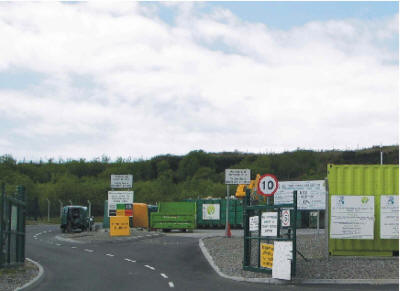
sites. A new civic amenity site has recently been opened at the Tythegston
Landfill Site. Subject to adequate funding being made available by the NAW,
new civic amenity sites will be established in appropriate areas in the
County Borough. Other recycling proposals will be considered in relation to
their impact on other land uses and sites which are designated for
protection for nature conservation, as areas of archaeological or historic
interest, or as Landscape Conservation Areas or Green Wedges.
12.7.3. Recycling facilities for inert materials have already been
approved at Heol-y-Splott and Cornelly Quarry. Active quarrying areas are
often considered to be suitable for such proposals provided that there is no
residential development in close proximity and the access is satisfactory
for this purpose. Such facilities could be suitable similarly at Grove
Quarry in view of its location and close proximity to the strategic highway
network.
12.8. Waste Facilities for Major Developments
12.8.1. WASTE MINIMISATION & RECYCLING
POLICY W5
ALL PROPOSALS FOR MAJOR NEW DEVELOPMENT SHOULD INCLUDE PROVISION FOR THE
COLLECTION AND, WHERE
APPROPRIATE, TREATMENT OF WASTE LIKELY TO BE GENERATED BY THE FUTURE USE OF
THE LAND.
12.8.2. Proposals for major development, such as retail, industrial,
commercial or housing development should include details of the means of
waste collection and proposals for waste minimisation and recycling.
Collection banks are often provided through the goodwill of developers but
such arrangements should be promoted in all major development proposals in
order to maximise recycling possibilities.
12.9. Construction and Demolition Waste
12.9.1. RE-USE & RECYCLING OF MATERIALS
POLICY W6
ANY DEVELOPMENT PROPOSALS INVOLVING THE DEMOLITION OF MAJOR STRUCTURES OR
REMOVAL OF SIGNIFICANT QUANTITIES OF WASTE MATERIAL DURING CONSTRUCTION
SHALL IDENTIFY THE MEANS BY WHICH THE WASTE MATERIAL SHALL BE REUSED,
RECYCLED OR DISPOSED OF EITHER WITHIN OR OFF THE SITE.
12.9.2. In order to conserve natural resources, it is important to
maximise the re-use and recycling of materials wherever possible within the
proposed development itself or in other local construction schemes.
12.10. Special Waste
12.10.1. CONTROL OVER THE DISPOSAL OF SPECIAL WASTE
POLICY W7
DEVELOPMENT FOR THE DISPOSAL, STORAGE OR DISTRIBUTION OF SPECIAL WASTES WILL
BE PERMITTED ONLY WHERE THE ENVIRONMENTAL EFFECTS ARE CONSIDERED TO BE
ACCEPTABLE IN RELATION TO NEIGHBOURING LAND USES, IN PARTICULAR RESIDENTIAL
AMENITY AND SITES DESIGNATED FOR ENVIRONMENTAL PROTECTION.
12.10.2. Special waste, often requires special treatment facilities where
it can be processed to make it acceptable to deposit. Such facilities have
the potential to cause significant adverse effects and therefore need to be
located in areas which have been carefully assessed to minimise
environmental impact.
12.10.3 Within the South West and South East Wales regions there is a
need to identify for hazardous waste facilities but it is extremely
difficult for individual authorities to justify site provision within their
own areas to meet regional need. The Regional Waste Plans have identified
the capacity requirement for such waste per unitary authority but have not
given adequate guidance on this issue to- date to enable the sustainable
waste management planning of such sites within the region. Whilst the need
for such sites is acknowledged the issue will need to be discussed further
by technical working parties as part of the regional waste planning process,
and monitored and reviewed under the formal UDP review procedure.
12.11. Civic Amenity Site Proposals
12.11.1. PROVISION OF CIVIC AMENITY SITES
POLICY W8
PROPOSALS FOR THE DEVELOPMENT OF CIVIC AMENITY FACILITIES TO HANDLE DOMESTIC
WASTE OTHER THAN THAT COLLECTED BY DOOR TO DOOR COLLECTIONS (EXCLUDING WASTE
DISPOSAL/TRANSFER) WILL BE PERMITTED WHERE:-
1. THERE IS NO UNACCEPTABLE IMPACT ON THE AMENITY OF LOCAL RESIDENTS THROUGH
NOISE, DUST, VIBRATION, SMELLS OR VERMIN;
2. THE TRAFFIC GENERATED CAN BE ACCOMMODATED SAFELY ON THE EXISTING HIGHWAY
NETWORK;
3. SATISFACTORY ARRANGEMENTS CAN BE MADE TO PREVENT POLLUTION OF SURFACE OR
UNDERGROUND WATER SYSTEMS/SUPPLIES;
4. NATURE CONSERVATION INTERESTS WOULD BE PROTECTED;
5. VISUAL IMPACT CAN BE MITIGATED BY APPROPRIATE LANDSCAPING AND SCREENING;
AND
6. THE PROPOSALS ARE COMPATIBLE WITH SURROUNDING LAND USES.
12.11.2. In order to meet the provisions of the Environmental Protection
Act 1990, the Council will need to provide opportunities for civic amenity
site(s) to be strategically placed within the County Borough. This will
hopefully encourage people to dispose of their household waste, including
garden materials, in a satisfactory manner. Three sites have recently been
granted planning permission in Maesteg, Brynmenyn and Ogmore Vale which
should be implemented in 2004/5.
12.11.3. It is considered inappropriate and impractical to make specific
allocations for such sites given the need to give careful consideration to
such proposals taking into account the nature of the development and the
surrounding area. Proposals will, however, be generally encouraged towards
existing areas or allocations for general industry, unless it can be
demonstrated that they could be located elsewhere without causing
unacceptable environmental impact.
12.11.4. Suitable sites within the County Borough need to be located in
areas which are central to main settlement areas to reduce unnecessary
vehicle movements. Hence, it is considered that industrial sites such as
Brynmenyn, Litchard, and Village Farm, Pyle, would be deemed acceptable in
principle for such use.
12.12 Green Waste
12.12.1 GREEN WASTE COMPOSTING FACILITIES
POLICY W9
PROPOSALS FOR GREEN WASTE COMPOSTING FACILITIES WILL BE PERMITTED PROVIDED
THEY MEET ALL OF THE FOLLOWING CRITERIA: -
1. THERE IS NO UNACCEPTABLE IMPACT ON THE AMENITY OF LOCAL RESIDENTS THROUGH
NOISE, DUST, VIBRATION, SMELLS OR VERMIN;
2. THE TRAFFIC GENERATED CAN BE ACCOMMODATED SAFELY ON THE EXISTING HIGHWAY
NETWORK;
3. SATISFACTORY ARRANGEMENTS CAN BE MADE TO PREVENT POLLUTION OF SURFACE OR
UNDERGROUND WATER;
4. NATURE CONSERVATION INTERESTS WOULD BE PROTECTED OR SUITABLE MITIGATION
MEASURES IMPLEMENTED;
5. THERE IS NO UNACCEPTABLE VISUAL IMPACT OR IT CAN BE MITIGATED BY WAY OF
LANDSCAPING / SCREENING TO AN ACCEPTABLE DEGREE; AND
6. THERE IS NO SIGNIFICANT CONFLICT WITH SURROUNDING LAND USES.
12.12.2. Green waste composting is considered to be an essential
component of sustainable waste management. Such facilities, especially open
green waste composting, otherwise referred to as ‘windrow’, can be likened
to an agricultural operation in many respects, and can be located in the
countryside as an appropriate exception to
Policy EV1 in terms of farm
diversification. It is essential that such operations are physically
divorced from occupied dwellings and other sensitive landuses so that the
effect of emissions of bioaerosols are minimised.
12.12.3. One of the key issues to be considered in relation to such
facilities in the countryside is traffic generation and the ability of rural
road networks with narrow and twisting lanes to accommodate traffic. There
is also the ability of such roads to absorb the movement of heavy vehicles
without detriment to the safety of highways users who may include walkers /
cyclists enjoying the quiet character of such rural areas. Each application
will, therefore, be required to give careful assessment to such issues.
12.13. Commercial and Industrial Waste
12.13.1 COMMERCIAL AND INDUSTRIAL WASTE FACILITIES
POLICY W10
PROPOSALS FOR THE TREATMENT, PROCESSING, AND
DISTRIBUTION OF COMMERCIAL AND INDUSTRIAL WASTE SUCH AS: -
(i) MATERIAL RECYCLING FACILITIES (MRF)
(ii) MECHANICAL BIOLOGICAL TREATMENT (MBT) OR
(iii) IN-VESSEL / ANAEROBIC DIGESTION COMPOSTING FACILITIES
WILL BE PERMITTED AT APPROPRIATE LOCATIONS WITHIN INDUSTRIAL ESTATES WITH
SPECIFIED USE CLASS B2 PROVIDED THEY MEET ALL OF THE FOLLOWING CRITERIA: -
1. THERE IS NO UNACCEPTABLE IMPACT ON THE AMENITY OF LOCAL RESIDENTS OR
ADJOINING INDUSTRIAL USERS THROUGH NOISE, DUST, VIBRATION, SMELLS OR VERMIN;
2. SATISFACTORY ARRANGEMENTS CAN BE MADE TO PREVENT THE POLLUTION OF SURFACE
OR UNDERGROUND WATER;
3. THE TRAFFIC GENERATED CAN BE ACCOMMODATED SAFELY ON THE EXISTING HIGHWAY
NETWORK, AND
4. A PROGRAMME OF SITE MANAGEMENT IS AGREED FOR THE DURATION OF THE
DEVELOPMENT.
12.13.2. A significant part, approximately 50 – 60% of the total waste
generated comprises commercial and industrial waste which takes a number of
forms. Such waste may be glass / paper / metal / wood / or plastic which are
suitable for recycling and facilities that handle and process them are
usually termed materials recycling facilities (MRF’s). Other wastes, termed
residual wastes, are derived from other recycling processes and may require
pre-treatment using mechanical and biological processes to stabilise the
waste. Typical plants generate three main material streams i.e. recyclable
material comprising mainly ferrous / non-ferrous metals; a bio-stabilised
stream suitable for landfill cover; and a residual stream that can be
landfilled or converted into a secondary fuel. In-vessel / anaerobic
digestion is a process where biodegradable material is encouraged to break
down in the absence of oxygen, in an enclosed vessel. It produces carbon
dioxide, methane and solids / liquors known as digestate, which can be used
as fertiliser and compost.
12.13.3. This policy is consistent with and should be considered in
association with Policy E7 which allows sui generis employment uses in
appropriate locations on industrial land. Waste treatment uses are normally
classed as sui generis for the purposes of the Use Classes Order.
<<
Previous Chapter |
Next Chapter
>> |